Digital Yacht AIT6000: a Game-Changer for Boaters
We see a lot of marine electronics come and go. The industry is currently moving away from isolated, single-function instruments and shifting towards highly integrated, wireless data hubs.
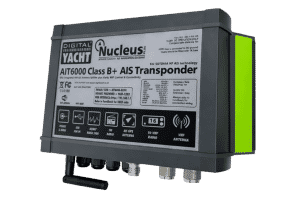
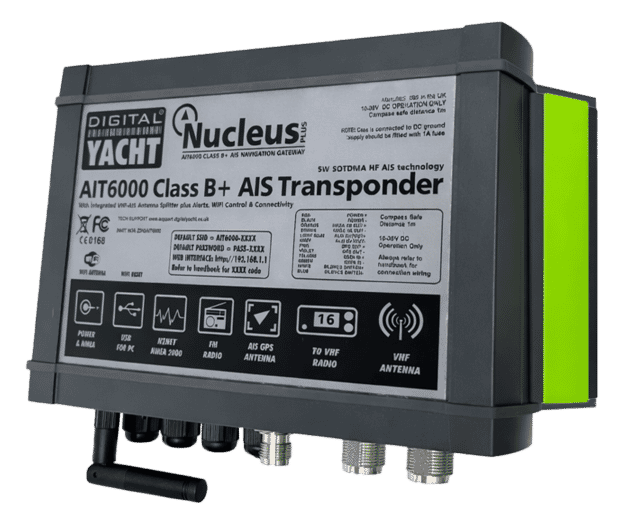
Digital Yacht has just released their new "Nucleus" Class B+ AIS Transponder, the AIT6000, in April 2026. It is designed to replace the highly successful AIT5000. Having had a good look at the technical specifications, I can confidently say this isn't just a minor tweak - it completely redefines the role of an AIS transponder on your boat.
Whether you are a seasoned offshore sailor or a technically minded DIYer looking to upgrade your NMEA network, here is a breakdown of why the AIT6000 is worth your attention.
The Basics: Class B+ Power and Zero Antenna Hassle
Before diving into the networking wizardry, let's look at the core AIS functionality. Like its predecessor, the AIT6000 uses the Class B+ SOTDMA architecture.
- Packs a Punch: It transmits at a solid 5 Watts of power, which is a massive 250% increase over older, traditional 2 Watt Class B units. This helps your signal punch through heavy rain and background noise.
- Guaranteed Time Slots: Unlike older units that politely waited for a gap in radio traffic, the AIT6000 actively reserves its transmission slots on the global AIS network. This ensures larger commercial ships always see you on their radar overlays, even in busy areas like the English Channel.
- Dynamic Updates: If you are travelling fast, the unit automatically increases its transmission rate to update your position every 5 seconds.
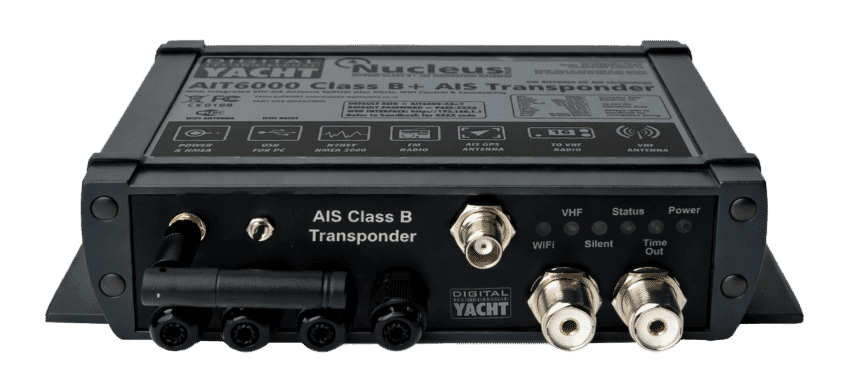
One of the biggest headaches when retrofitting AIS is antenna placement. The AIT6000 features a patented, built-in "ZeroLoss" VHF splitter. This sophisticated internal matrix lets you safely share your primary masthead VHF antenna with the AIS transponder and an FM radio simultaneously. It actively amplifies the incoming signal to compensate for any division loss, guaranteeing pristine voice clarity for your VHF radio and maximum digital range for the AIS.
The Real Magic: Built-in NMEA 2000 Multiplexing
This is where the AIT6000 truly separates itself from the AIT5000. Previously, if you wanted to beam your NMEA 2000 instrument data (like wind, depth, or engine stats) over Wi-Fi to an iPad, you had to buy and wire in a separate gateway device, like an iKonvert.
The AIT6000 fundamentally changes this by including a powerful, built-in NMEA 2000 gateway and multiplexing processor.
- Simple Integration: It connects directly to your modern CAN bus via a standard Micro-C cable. It draws a remarkably low Load Equivalency Number (LEN) of exactly 1 (just 50mA), meaning it won't overload your complex marine network.
- Total Vessel Telemetry: The internal processor reads all your NMEA 2000 data - from boat speed and fluid levels to rapid-update engine parameters - and packages it alongside your precise GPS and AIS targets.
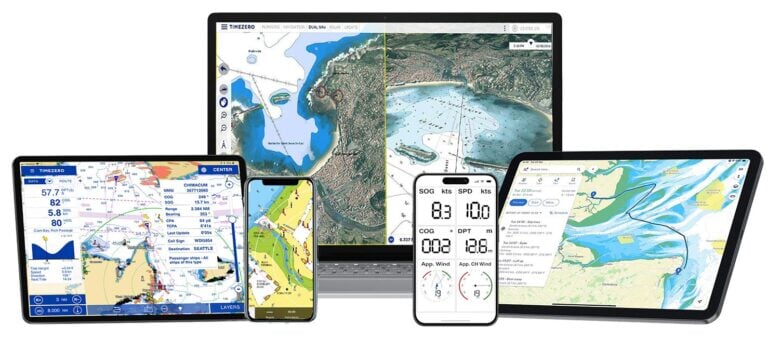
- Bidirectional Wi-Fi: It broadcasts this data over its secure Wi-Fi network to up to seven smart devices at once. Because the Wi-Fi is bidirectional, you can plot a route on a tablet app like Navionics or TZ iBoat from the saloon, and the AIT6000 will translate that route back into NMEA 2000 instructions to physically steer your autopilot.
Autonomous Safety: Waking You Up When It Matters
Historically, collision alarms relied on your power-hungry MFD being switched on to calculate the vectors. If the chartplotter crashed or you turned it off to save your batteries on a long passage, you lost your alarms.
The AIT6000 solves this through autonomous edge computing. It calculates Closest Point of Approach (CPA) and Time to Closest Point of Approach (TCPA) internally. It also handles an intelligent anchor drift geofence that uses live depth data to calculate a realistic swing radius.
Most crucially for safety, the wiring harness includes a dedicated, physical alarm relay circuit. You can hardwire these two physical wires directly to an ultra-loud 12V/24V buzzer or strobe light. If an alarm is triggered, this physical relay guarantees you will be woken up, even if every digital screen on the boat is completely shut down.
Global Tracking and Setup Simplified
For blue-water cruisers heading beyond the 20 to 30 nautical mile line-of-sight limitation of standard VHF, the AIT6000 includes proprietary SPAIS (Space AIS) technology. This optimises the unit's transmissions to be successfully decoded by Low Earth Orbit (LEO) satellites. It provides unprecedented global tracking for offshore sailors, allowing family and rescue authorities to monitor your precise location anywhere in the world.
Finally, Digital Yacht has made the setup incredibly frictionless. Gone are the days of needing a laptop, a USB cable, and CD-ROM drivers. You simply connect your smartphone to the AIT6000's Wi-Fi network and open a web browser to its local IP address. This beautifully rendered HTML portal lets you input your MMSI number, configure alarms, and check critical diagnostics.
Final Thoughts
The Digital Yacht AIT6000 represents a massive, generational technology upgrade over the old AIT5000. By acting as a central data aggregation hub rather than just a simple transmitter, it neatly bridges the gap between legacy wiring, modern NMEA 2000 networks, and consumer Wi-Fi devices.
The best part? Despite the significant jump in technology, Digital Yacht has managed to keep this new generation at the same price point as the outgoing model. If you are looking to modernise your vessel's electronics and vastly improve your safety systems without the "new tech" premium, this unit should be right at the top of your list.